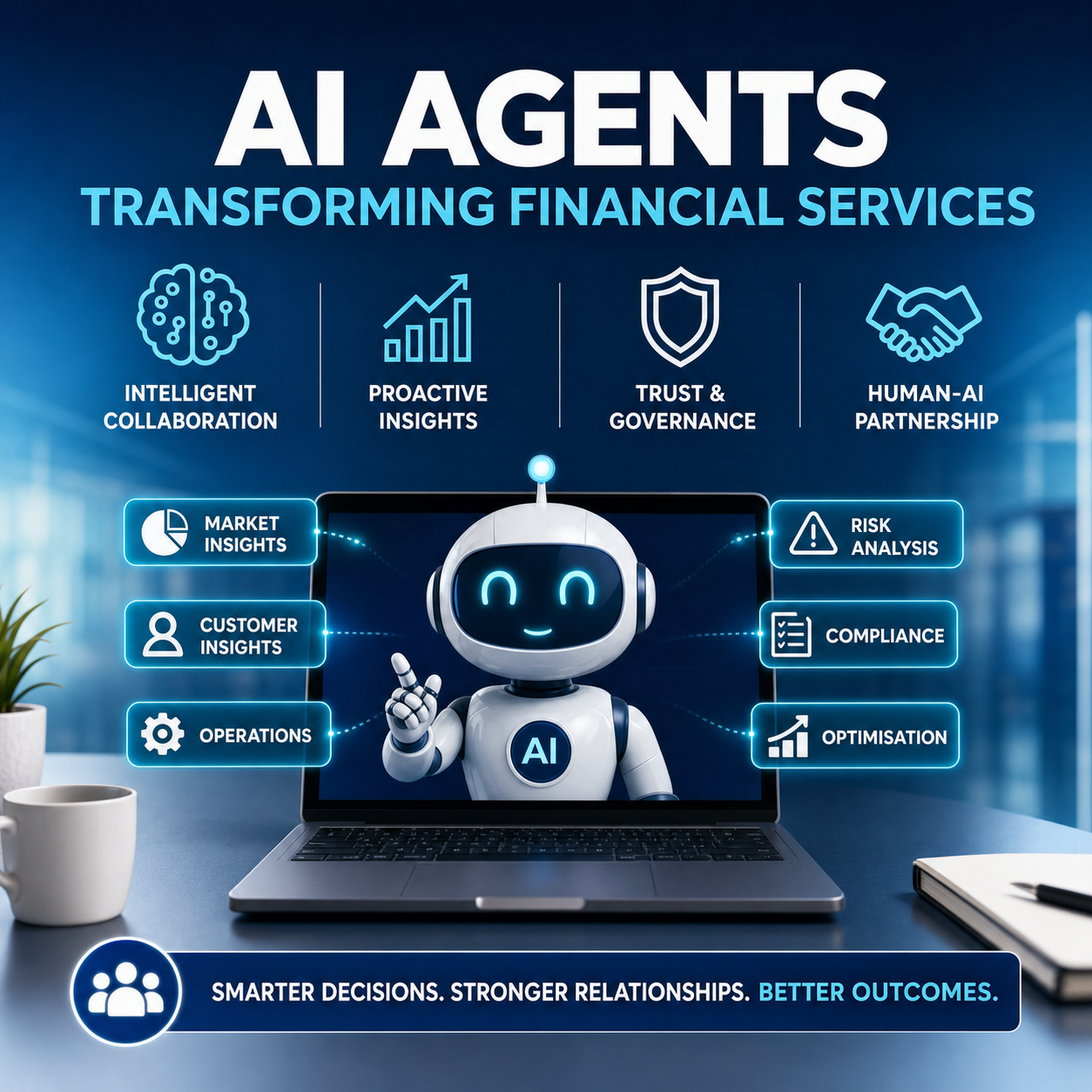
For years, technology investments in financial services were driven by a clear objective: improving efficiency. From core banking systems and online platforms to digital transformation initiatives, technology was primarily deployed to optimise processes, reduce costs, strengthen controls and enhance customer experience. Today, however, the industry is entering a new phase. While efficiency remains important, financial institutions are increasingly looking to technology, data and AI as drivers of business growth and competitive advantage. Financial institutions are leveraging advanced analytics and AI to strengthen fraud detection and risk management, unlock new revenue streams by exploring adjacent businesses and customer segments, personalise products and services, and identify new market opportunities. With the rapid advancement of generative AI and large language models (LLM), the transformation runs deeper than process optimisation. It is redefining how financial institutions create value, make decisions and grow their businesses. AI was once seen mainly as a tool for analysing data or automating tasks. Today, it is evolving into AI agents capable of understanding, reasoning, planning and collaboration. These agents do more than answer questions. They execute tasks autonomously based on objectives, integrate multiple systems and knowledge sources, and even coordinate with other AI agents to complete complex work. The implications are far more profound than another wave of automation. If the competitive advantage of financial institutions over the past two decades has been built on digital capabilities, the next decade will likely hinge on whether they can build and harness an effective digital workforce powered by AI agents. As a key research institution in Hong Kong’s innovation and technology ecosystem, the Hong Kong Applied Science and Technology Research Institute (ASTRI) has observed the industry’s focus shift from proof of concept to scaled deployment. The question is no longer how advanced the models are, but how to embed AI into core operations securely, compliantly and sustainably to create genuine commercial value. Turning Knowledge into Decision Power The financial sector’s core challenge is not a lack of data. It is the inability to use knowledge effectively. Information sits fragmented across systems, reports, policy documents and business units. Employees spend significant time searching, verifying and consolidating insights. When AI agents combine enterprise knowledge bases, multimodal document processing and knowledge graph technology, scattered information transforms into an interconnected knowledge network. Access to knowledge shifts from searching for information to receiving actionable insights. This enables organisations to convert individual experience into shared, continuously evolving intellectual assets. From Risk Management to Strategic Foresight This capability matters especially in risk management. Financial risk is rarely a standalone event. Corporate relationships, ownership structures, transaction networks, market movements and regulatory factors intertwine in ways traditional methods struggle to capture. Through AI agents and knowledge graphs, institutions are moving from analysing data to understanding relationships, detecting potential risks and anomalies earlier. Risk management is shifting from reactive response to predictive management and proactive prevention. Future differentiation will depend less on who holds more data and more on who spots risk signals sooner and converts insights into decision advantage. The same shift is transforming regulatory compliance. Compliance has long been seen as necessary but costly. When AI agents continuously monitor regulatory changes, automatically assess the impact of new rules on operations, and support remediation tracking, compliance becomes more than risk mitigation. It evolves into a strategic function that strengthens resilience and responsiveness. Reshaping Financial Services Experience Customer expectations are changing too. In an era where personalisation is the norm, clients no longer accept passive responses. They expect institutions to understand their needs, anticipate requirements and offer proactive advice. Future financial services may not be delivered by a single relationship manager but by a digital team of specialised AI agents. These agents can simultaneously handle knowledge retrieval, product analysis, risk assessment and customer interaction, delivering service that is more immediate, consistent and personalised. The Real Competition Is About Trust, Not Just AI Yet the real challenge of AI agents is not technical deployment. It is a shift in management mindset. When AI moves from tool to collaborator, organisations must rethink the division of labour between humans and machines, and establish trustworthy, secure and governed collaboration models. For financial services, efficiency matters, but trust remains the most valuable asset. The most successful institutions will not be those with the most AI models, but those that best integrate AI innovation with robust risk governance. Looking back, digitalisation made processes faster. Today, AI agents are making knowledge, decisions and services more intelligent. This is not simply a technology upgrade. It is a fundamental restructuring of organisational capability. As a bridge between research innovation and industrial application, ASTRI works closely with the financial sector to advance AI agent adoption across core scenarios including risk management, regulatory compliance, knowledge management and customer service. These initiatives demonstrate that AI agents have moved beyond proof of concept to enterprise-grade deployment. ASTRI believes that future competitive advantage of financial institutions will depend not simply on how digital they are, but on how effectively they combine AI, knowledge and trust to build intelligent operational capability. As the industry transitions from digitalisation to intelligence, ASTRI looks forward to collaborating with financial institutions to explore and implement innovative AI agent applications, advancing Hong Kong’s financial sector towards a more intelligent, efficient and competitive future. Learn more: corporate@astri.org